Chinese

What Should You Know About Outdoor Lighting Import into the USA?
Outdoor lighting import into the USA is not simply a matter of booking a container and filing customs paperwork. The product configuration should be reviewed before shipment because HTS classification, country of origin, product safety requirements, and wireless functions can change the import process. For regulated consumer products, CPSC certificate requirements and electronic filing also need to be checked. A practical import plan should therefore connect four things: product compliance, customs classification, transportation, and landed cost. For most commercial shipments, the safest workflow is to confirm the product details first, verify the applicable HTS classification and documents, then choose the shipping method and U.S. delivery plan.
What Makes Outdoor Lighting Import Different from Ordinary Cargo?
Outdoor lighting looks straightforward until the product reaches the customs-entry stage.
A shipment may contain wall lights, landscape lights, floodlights, pathway lights, street lighting, solar lighting, decorative fixtures, or smart lighting systems. They may look similar from a logistics perspective, but their electrical configuration, materials, control systems, intended use, and wireless functions can be very different.
That difference matters because the import process is built around the actual merchandise, not simply the commercial name written on the purchase order.
For example, a conventional wired outdoor lamp and a Wi-Fi-enabled smart lighting controller should not automatically be treated as the same compliance category. The latter may involve RF equipment authorization considerations, while the former may not have the same FCC issue.
That is why we normally start an outdoor lighting import review with the product itself rather than starting with the freight rate.
| Product Information | Why It Matters | What to Confirm |
|---|---|---|
| Lighting function | Affects classification and regulatory review | Outdoor wall, flood, landscape, street, decorative, etc. |
| Power source | Changes product configuration | AC, DC, battery, solar, integrated driver |
| Wireless function | May trigger FCC equipment authorization review | Wi-Fi, Bluetooth, Zigbee or other RF functionality |
| Materials | Can affect classification and compliance | Aluminum, steel, plastic, glass, wood components |
Which Documents Should Be Prepared Before Outdoor Lighting Import?
The basic customs package should be prepared before the cargo leaves the origin country.
CBP states that a commercial invoice submitted with an entry should contain an adequate description of the merchandise, quantities, values or approximate values, and the appropriate eight-digit HTSUS subheading. The invoice should also identify the foreign party responsible for invoicing the merchandise. (Source: U.S. CBP, Commercial Invoice Requirements, November 4, 2025)
For outdoor lighting, the description needs to be more useful than simply writing “LED lights.” A better commercial description identifies the product type and relevant characteristics.
Before shipment, we normally recommend checking the following:
- 1.Commercial invoice
- 2.Packing list
- 3.Purchase order or sales documentation
- 4.Product description and technical specification
- 5.Applicable test reports or compliance documents
- 6.Country-of-origin information
- 7.Product photographs
- 8.Packaging details and carton dimensions
- 9.Wireless specifications when applicable
- 10.Importer and customs broker information
The point is not to create paperwork for its own sake. The point is to make sure the product described in the entry actually matches the product inside the container.
A mismatch such as “outdoor lighting” on the invoice while the actual product is a smart lighting system with a wireless controller can create questions that should have been resolved before the vessel departed.
For importers unfamiliar with U.S. customs procedures, the customs clearance stage should be planned together with the shipping arrangement rather than treated as a separate step after arrival.
How Should You Determine the HTS Code for Outdoor Lighting?
This is one of the areas where copying another importer's HTS code can create problems.
CBP explains that the HTS provides the tariff classifications and rates applicable to imported merchandise, while CBP administers and enforces the tariff schedule. CBP also states that the duty rate depends on the information used to classify the specific product. (Source: U.S. CBP, Harmonized Tariff Schedule - General Information, February 13, 2026)
Outdoor lighting products are often associated with heading 9405, but that does not mean every product marketed as outdoor lighting automatically receives the same eight-digit classification.
The classification review should consider:
- 1.What the product actually does.
- 2.Whether it is a complete lighting fixture or a component.
- 3.The principal construction and materials.
- 4.Whether the product includes additional electrical or electronic functions.
- 5.Whether a controller or communication function changes the nature of the merchandise.
- 6.The country of origin.
- 7.Any applicable Chapter 99 provisions or additional trade measures.
When the classification is unclear, a customs broker or importer should not simply select the code with the lowest duty rate. CBP provides a binding ruling process for classification questions, which can be used when a more definitive determination is needed.
The practical rule is simple: classify the product you are actually importing, not the product name used by the factory.
Does Outdoor Lighting Import Require CPSC Compliance?
Not every outdoor lighting product should automatically be described as requiring the same CPSC certification.
CPSC explains that general-use products subject to an applicable consumer product safety rule or similar requirement may require a General Certificate of Conformity. Starting July 8, 2026, importers of most regulated consumer products are also required to electronically file applicable certificate data with CBP through the PGA Message Set. (Source: U.S. CPSC, eFiling implementation, July 8, 2026)
This distinction is important.
The correct question is not “Does outdoor lighting need CPSC?” The better question is:
“Is this specific outdoor lighting product subject to a CPSC-enforced safety requirement that triggers certification?”
If the answer is yes, the importer should make sure the certificate, supporting testing information, product identity, and entry information are consistent.
CPSC's current eFiling guidance also requires relevant certificate information to be submitted electronically for covered imported products. The certificate data can include applicable rules, testing dates, testing laboratories, and other required information. (Source: U.S. CPSC, eFiling FAQ, 2026)
That makes pre-shipment compliance review more valuable than trying to resolve everything after the container reaches the U.S.
When Does FCC Become Relevant to Outdoor Lighting?
FCC should not be treated as a universal requirement for every outdoor lamp.
The key issue is whether the lighting product or its associated electronics contain radio-frequency functions that fall under FCC equipment authorization requirements.
For example, a smart outdoor lighting system may include Wi-Fi, Bluetooth or another wireless communication function. In such a situation, the RF portion needs to be reviewed under the applicable FCC rules.
The FCC states that RF devices are subject to its equipment authorization framework before being marketed or imported into the United States. (Source: FCC Office of Engineering and Technology, Equipment Authorization System guidance)
So the review should be product-specific:
| Product Type | FCC Review | Practical Question |
|---|---|---|
| Basic wired outdoor lamp | Usually not treated like an RF transmitter | Does the product contain any RF function? |
| Wi-Fi lighting | FCC review may apply | What wireless module and authorization are used? |
| Bluetooth lighting controller | FCC review may apply | Is the RF function already properly authorized? |
| Lighting fixture with separate controller | Depends on the controller configuration | Is the controller part of the imported merchandise? |
That is why asking for the product specification sheet before booking is often more useful than asking only for the carton count.
How Should You Calculate the Landed Cost of Outdoor Lighting Import?
The freight quote is only one part of the landed cost.
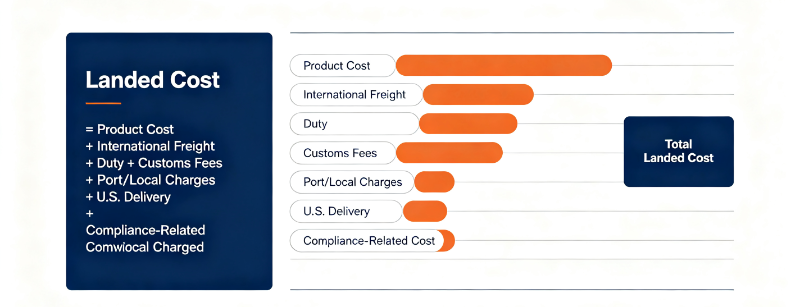
As shown in the figure, for a normal ocean shipment, the cost model can be viewed as:
Landed Cost = Product Cost + International Freight + Duty + Customs Fees + Port/Local Charges + U.S. Delivery + Compliance-Related Cost
CBP currently lists the formal-entry MPF at 0.3464% of the applicable merchandise value for fiscal year 2026, subject to a $33.58 minimum and $651.50 maximum. For qualifying ocean cargo, HMF is generally 0.125% of commercial cargo value. (Source: U.S. CBP, Merchandise Processing Fee, March 2, 2026; Duty, Taxes and Other Fees, February 13, 2026)
These figures should not be treated as the total import cost because the duty itself depends on the actual HTS classification and applicable trade measures.
For example, if an importer compares two freight quotes and one is $500 lower but has not included destination handling, customs brokerage, or delivery, the cheaper ocean rate may not produce the lower landed cost.
Outdoor lighting also deserves a packaging allowance. Glass shades, long aluminum bodies, delicate finishes and multi-piece fixtures can create costs after customs release if packaging is inadequate.
We therefore prefer to compare the entire logistics chain rather than compare only the ocean freight line.
What Shipping Risks Should You Watch for with Outdoor Lighting?
Outdoor lighting often has an awkward combination: relatively high carton count, fragile components, long pieces and different SKUs.
The biggest operational risks are usually not mysterious. They come from insufficient packaging, incorrect carton information, mixed SKU identification, unexpected delivery requirements or a customs review that was not prepared in advance.
One ANL case published in March 2026 involved a U.S.-bound construction-material shipment containing approximately 1,000 LED ceiling lights, 500 faucet sets and 2,000 boxes of tiles. The original logistics arrangement experienced product damage and downstream warehouse problems. After changing the transportation and warehouse plan, the published case reported a reduction in lighting damage to about 0.5%, overall damage to about 0.8%, and a logistics-cost reduction of about 22%.
The lesson was not simply “use a better freight forwarder.” The bigger lesson was that packaging, port selection, customs preparation, warehouse receiving and final delivery had to be treated as one operation.
For outdoor lighting, I would check these points before loading:
- 1.Can the carton withstand double handling?
- 2.Are glass components separately protected?
- 3.Are long fixtures supported against bending?
- 4.Are SKUs clearly separated and labeled?
- 5.Does the packing list match the physical cartons?
- 6.Can the U.S. warehouse receive the actual carton dimensions?
- 7.Does the final delivery require liftgate or special handling?
For larger or unusually long fixtures, the oversized logistics planning should be considered before the cargo is packed, not after it arrives at the U.S. warehouse.
Can a Real Outdoor Lighting Shipment Be Planned Differently?
Yes. The transportation solution should change according to shipment characteristics rather than follow one fixed route.
In another ANL-published case from August 2025, the team handled 42 high-cube containers originating in Ho Chi Minh City, Vietnam, for a Manhattan hotel project. The cargo included custom solid-oak wardrobes, marble-topped vanities and fragile lighting assemblies. A CBP intensive examination was triggered by a wood-species documentation issue under the Lacey Act. ANL obtained botanical documentation from the Vietnamese mill within 24 hours, moved containers to an off-dock warehouse, devanned the cargo, rebuilt protective pallets and arranged controlled nighttime deliveries. The published case reported that this avoided more than $45,000 in threatened union labor standing fees.
This case was not an ordinary retail outdoor-lighting shipment, but it shows an important logistics principle: when cargo includes fragile lighting alongside large project materials, the customs and delivery plan can materially affect the final cost.
The public case record does not disclose the individual dimensions and weights of the lighting assemblies, so those details should not be invented when using the case as an industry example.
For commercial outdoor lighting imports, we normally evaluate:
- · Origin port and destination port
- · Container utilization
- · Carton dimensions and weight
- · Fragility
- · U.S. warehouse receiving requirements
- · Final delivery location
- · Need for liftgate, appointment or special equipment
- · Customs and product-compliance readiness
Depending on the shipment, the appropriate solution may be ocean freight, air freight, a full-container arrangement, or a warehouse-based delivery plan.
What Should Importers Check Before the Cargo Leaves Asia?
The easiest time to correct an import problem is before the container is sealed.
Our pre-shipment review can be reduced to six questions:
- 1.What exactly is the product? Confirm the lighting type, materials, power source and functions.
- 2.What is the correct HTS classification? Do not copy an old code without checking the current product configuration.
- 3.Does a CPSC requirement apply? If certification is required, confirm the certificate and eFiling requirements.
- 4.Does the product contain RF functionality? If yes, review FCC equipment authorization requirements.
- 5.Do the invoice and packing list accurately describe the cargo? The customs entry should match the physical shipment.
- 6.Can the U.S. delivery network handle the actual cargo? Confirm warehouse receiving, appointment, dimensions and delivery equipment before departure.
For importers moving regular volumes, building this checklist into the purchasing and booking process is more efficient than checking every requirement after the vessel sails.
For companies that need a complete China-to-U.S. logistics arrangement, ANL provides China to USA logistics covering ocean freight, customs clearance, U.S. warehousing and delivery coordination.
What Is the Practical Way to Control Outdoor Lighting Import Risk?
There is no single document or single freight method that eliminates every outdoor lighting import risk.
The practical approach is to connect the product, compliance, customs and logistics decisions before shipment.
If the product is a conventional wired fixture, the focus may be classification, documentation, packaging and transportation. If it is a smart lighting system, the compliance review may become broader because wireless functionality can introduce FCC considerations. If it is a consumer product subject to a CPSC requirement, the importer should also account for the current certificate and eFiling framework.
The cost calculation should then be built around the complete landed-cost chain rather than the ocean freight rate alone.
That is also why two outdoor lighting shipments with the same number of cartons can have very different logistics costs. One may fit efficiently into a container and move directly to a prepared warehouse. Another may require additional handling, special delivery equipment, compliance work or redistribution after arrival.
For an importer, the useful question is therefore not simply “How much is shipping outdoor lighting to the USA?”
The better question is: “What product am I importing, what requirements apply to it, and what logistics plan gets it from the factory to the U.S. destination without creating avoidable cost?”
Review your product configuration, HTS classification, compliance documents and U.S. delivery requirements before booking.
References
- · U.S. Customs and Border Protection — Commercial Invoice Requirements: https://www.help.cbp.gov/s/article/Article-1175?language=en_US
- · U.S. Customs and Border Protection — Harmonized Tariff Schedule - General Information: https://www.help.cbp.gov/s/article/Article-1015?language=en_US
- · U.S. Customs and Border Protection — How Do I Determine the Duty Rate on My Goods?: https://www.help.cbp.gov/s/article/Article-1344
- · U.S. Customs and Border Protection — Merchandise Processing Fees: https://www.help.cbp.gov/s/article/Article-1128?language=en_US
- · U.S. Customs and Border Protection — Duty, Taxes and Other Fees: https://www.help.cbp.gov/s/article/Article-1225?language=en_US
- · U.S. Consumer Product Safety Commission — CPSC eFiling: https://www.cpsc.gov/content/eFiling
- · U.S. Consumer Product Safety Commission — Mandatory eFiling Announcement, July 8, 2026: https://www.cpsc.gov/Newsroom/News-Releases/2026/CPSC-Implements-Mandatory-eFiling-for-Certificates-of-Compliance-Targeting-Dangerous-Foreign-Imports
- · U.S. Consumer Product Safety Commission — eFiling FAQ: https://www.cpsc.gov/FAQ/eFiling-Frequently-Asked-Questions-FAQ
- · Federal Communications Commission — Equipment Authorization System: https://opendata.fcc.gov/Engineering-Technology/EAS-Equipment-Authorization-Grantee-Registrations/3b3k-34jp
- · AMERICAN NEW LOGISTICS — Customs Clearance: https://en.anl-cn.com/pages/CustomsClearance.html
- · AMERICAN NEW LOGISTICS — Ocean Freight: https://en.anl-cn.com/pages/seafreight.html
- · AMERICAN NEW LOGISTICS — Oversized Logistics: https://en.anl-cn.com/pages/oversized.html
This article was compiled with AI assistance to gather industry data, and then manually reviewed, revised, and finalized by ANL specialist.