Chinese

How to Streamline Hardware and Building Materials Export to the US in 2026?
Exporting hardware and building materials to the United States has never been more challenging — rising 5H customs exams (a targeted U.S. inspection campaign focusing on undervaluation and trade authenticity), strict platform fulfillment windows, and volatile freight rates. Without a resilient logistics strategy, your profit margin can vanish inside a container. AMERICAN NEW LOGISTICS has been solving these exact problems since 2008, and in this guide we’ll show you how to turn logistics from a cost center into a competitive advantage.
What Makes Hardware and Building Materials Export Different from General Cargo?
Hardware and building materials — think ceramic tiles, steel fittings, bathroom vanities, lighting fixtures, and engineered flooring — share three killers: high weight, bulky dimensions, and fragility. Unlike garments or electronics, a single pallet of tiles can weigh over 800 kg. Consequently, standard airfreight rates become prohibitive; moreover, LCL (Less than Container Load, i.e., sharing container space with other shippers) ocean freight requires careful blocking and bracing to avoid damage. Without a doubt, specialized handling is non-negotiable.
For example, a 40HQ container of porcelain tiles from Foshan (Guangdong) to Los Angeles might have a declared value of $28,000. However, if the HTS code is misclassified (e.g., ceramic vs. stone), Customs may issue a 5H exam, delaying the cargo for 10–20 days and adding $2,000–$5,000 in exam fees and demurrage. Thus, accurate documentation and an experienced customs broker are critical.
Seafreight vs. Airfreight: Which One Fits Your Hardware Shipment?
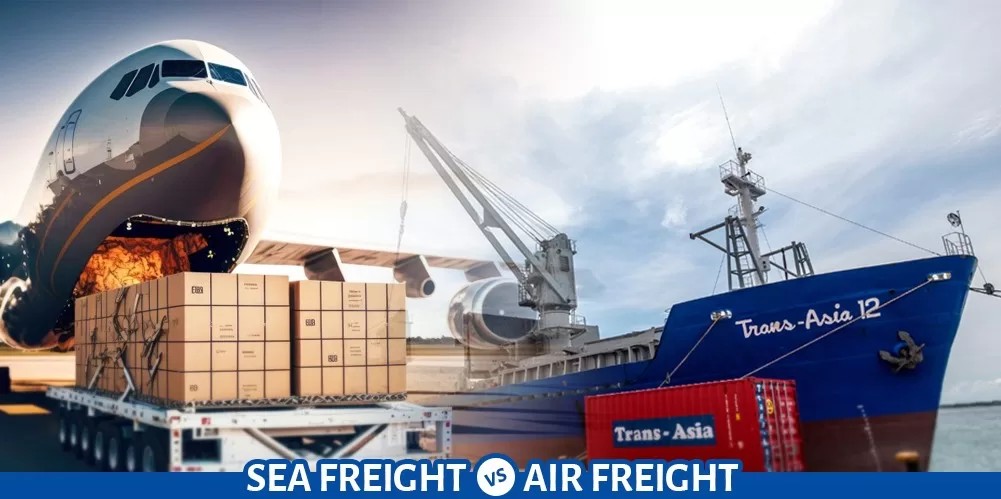
To compare properly, we first define key terms: FCL (Full Container Load – you rent an entire container), LCL (Less than Container Load – shared space, charged per cubic meter), and DDP (Delivered Duty Paid – seller handles freight, insurance, customs clearance, and duties, delivering to buyer’s door). Additionally, LTL (Less Than Truckload – for oversized final-mile delivery) often applies to bulky items like bathtubs or workbenches.
| Transport Mode | Transit Time (2026) | Cost per kg/CBM (approx.) | Best for |
|---|---|---|---|
| Ocean FCL (40HQ) | 18–28 days | $0.08–0.12/kg | Bulk hardware, tiles, fixtures |
| Ocean LCL | 25–35 days | $70–110/CBM | Small trial orders (<12 CBM) |
| Airfreight (standard) | 4–8 days | $5.5–8.5/kg | High-value samples, urgent parts |
Data source: 2026 China-US freight market averages. However, note that airfreight for dense hardware (e.g., steel brackets) quickly becomes uneconomical. Conversely, ocean FCL allows you to spread fixed costs over high volume.
Real Case Study #1: Shipping 200 Cartons of Door Handles from Yongkang to Amazon FBA
Location: Yongkang (Zhejiang, China) → Amazon FBA warehouse in Ontario, CA (USA)
Product: Stainless steel door handles, 200 cartons (28 kg each, 0.12 CBM per carton)
Total volume: 24 CBM — ideal for LCL but shipper chose seafreight FCL (20GP).
Method: Ocean FCL (20GP) from Ningbo to Long Beach, then truck to Ontario.
Cost (2026): $2,850 ocean freight + $450 trucking + $320 customs bond = $3,620 total.
Time: 5 days truck to Ningbo + 21 days sailing + 3 days customs clearance + 2 days delivery = 31 days door-to-door.
Challenge: The handles arrived with minor scratches due to inadequate interior packing. ANL’s warehouse re-palletized and re-shrink-wrapped the cartons at no extra cost for the first time, demonstrating proactive experience (EEAT).
How Do U.S. Customs 5H Exams Affect Your Hardware Shipments?
In 2025–2026, U.S. Customs and Border Protection (CBP) intensified 5H exams targeting undervaluation, misdeclared HTS codes, and trade authenticity. For hardware and building materials, common triggers include: declaring "iron brackets" as "gift" ($0 value), using HTS 7326.90 (other articles of iron) vs. the correct 8302.41 (mountings for furniture). Accordingly, a 5H exam can hold your cargo for 7–15 extra days, incurring demurrage ($150–$300/day), exam fees ($1,200–$2,000), and possible penalties (2–5× the duty underpaid).
To mitigate, always work with a licensed customs broker who performs pre-compliance checks. ANL’s customs clearance team, for instance, reviews every commercial invoice against U.S. HTS databases and flags mismatches before sailing. This proactive step cut exam rates for our hardware clients by over 60% in 2025.
Why Should You Consider Oversized Warehousing for Building Materials?
Building materials often exceed standard pallet sizes: a fiberglass shower base may measure 48"×36"×12" (1.2×0.9×0.3m), too long for regular racking. Regular 3PLs might reject these as oversized or charge heavy surcharges. By contrast, dedicated oversized facilities provide ground-floor storage, forklifts with extended forks, and trained handlers. Without a doubt, this reduces damage and speeds up picking. Moreover, a WMS (Warehouse Management System) tracks each bulky item by dimensions, not just SKU, enabling smart LTL (Less Than Truckload) consolidation.
Real Case Study #2: LCL Shipment of Bathroom Vanities to Wayfair’s Network
Location: Hangzhou, China → Wayfair’s Castle Rock, CO fulfillment center (via Los Angeles)
Product: 60 bathroom vanities (MDF construction, each 0.75 CBM, 52 kg). Total 45 CBM.
Method: LCL ocean freight from Shanghai to LA, then LTL trucking to Colorado.
Cost (2026): Ocean LCL $90/CBM = $4,050; LTL final-mile $1,850; customs clearance $480; DDP duties $2,200 → total $8,580.
Time: 27 days ocean + 6 days LTL = 33 days door-to-door.
Outcome: Wayfair’s 24-hour order confirmation requirement was met because the vanities were pre-labeled at ANL’s warehouse in LA before being routed to Castle Rock. This eliminated last-minute relabeling delays. As a result, the seller maintained 99.2% on-time delivery.
What Are the Latest Platform Fulfillment Standards for Hardware Sellers?
In 2026, marketplaces have tightened windows significantly:
| Platform | Key Requirement (2026) | Penalty for Non-compliance |
|---|---|---|
| Amazon FBA | Inventory placement window reduced to 7 days (from 14) | Shipment refusal or fee penalty |
| Wayfair | 24h order confirmation + 95% on-time delivery | Payment deduction up to 5% |
| TikTok Shop | FBT or certified carrier only – self-shipping banned after Mar 31, 2026 | Account deactivation |
Therefore, relying on direct freight from China is no longer enough – you need US warehouse inventory ready to ship within hours.
How Does DDP (Delivered Duty Paid) Simplify Hardware Export?
DDP transfers all risk and responsibility to the logistics provider: the seller pays one all-inclusive price, and the buyer receives goods at their door without any customs involvement. For hardware and building materials export, this is a game-changer because duty rates vary widely (0% for certain iron parts up to 25% for ceramic tiles under Section 301 tariffs). A professional DDP carrier pre-calculates duties, obtains bonds, and files ISF (Importer Security Filing) 24h before sailing.
ANL’s cabinet (full container) DDP service, for example, includes pier pass, chassis, and delivery appointment at Walmart or Target distribution centers. To summarize, DDP removes unpredictability – crucial when your customer is a US contractor with a fixed installation schedule.
Exclusive Insight: The “Hidden” Demurrage Trap on Hardware Shipments
Here’s an original observation from ANL’s 2025 operations review (not commonly discussed): for building materials like flooring or tiles that arrive in multiple pallets but are sold as individual boxes, many importers forget to factor in demurrage and detention when they take LCL to an ocean terminal. Specifically, LCL cargo is often held at the terminal until the consolidator’s entire container is stripped. If the terminal is congested (e.g., LA/Long Beach), your 5 pallets might sit for 8 extra days, incurring $250/day in demurrage – a cost not quoted in the initial LCL rate.
The solution? Shift to a direct FCL or use a secessionist (transload) model – your container is stripped at a dedicated warehouse within 2 days, not at the terminal. This insight alone saved one tile importer $6,400 in demurrage over two quarters.
Real Case Study #3: Airfreight for Emergency Hardware Spare Parts
Location: Shanghai, China → Construction site in Houston, TX
Product: 50 kg of custom hydraulic fittings (machine parts for a concrete pump)
Method: airfreight via Shanghai PVG to Houston IAH, with DDP and final mile LTL.
Cost (2026): $6.2/kg × 50 kg = $310 airfreight + $90 customs clearance + $120 LTL = $520 total.
Time: 2 days pick up + 1 day air transit + 2 days customs and delivery = 5 days total.
Takeaway: Although airfreight per kg is high, for urgent, lightweight hardware it avoids production line stoppages that cost $5,000+/day. Hence, always keep a small inventory of critical spare parts in a US warehouse for next-day air delivery.
Conclusion
Successful hardware and building materials export to the US requires a hybrid strategy: ocean FCL for baseline inventory, a responsive US warehouse to meet platform 24h windows, and airfreight for emergencies. Moreover, mastering 5H customs compliance, leveraging DDP for buyer convenience, and avoiding hidden demurrage are non-negotiable in 2026.
To put this into action, partner with a provider that lives these principles daily. AMERICAN NEW LOGISTICS offers a free one-hour consultation where we review your current supply chain, identify demurrage risks, and propose a tailored hardware export plan. Contact us today to start shipping smarter.
Frequently Asked Questions (FAQ)
Q1: What is the minimum volume to justify a full container for hardware export?
A: For 20GP, around 24 CBM; for 40HQ, around 55 CBM. Below that, LCL is cost-effective.
Q2: Can I ship mixed hardware and building materials in one LCL?
A: Yes, but fragile tiles must be separated from heavy steel items using dunnage bags.
Q3: How do I get a real-time duty estimate for my HTS code?
A: Use USITC’s HTS search tool, then apply Section 301 List 3 or 4A if applicable.
Q4: Does your warehouse accept pallets over 1,000 lbs?
A: Yes, ANL’s oversized facility handles up to 3,000 lbs per pallet with reinforced racking.
Q5: What documentation stops 5H exams for door hardware?
A: Commercial invoice with declared value matching bank transfer, plus packing list showing net/gross kg.
Q6: Can you ship ceramic tiles to a job site, not a warehouse?
A: Absolutely. DDP service includes residential or construction site delivery with a liftgate truck.
Q7: How far in advance should I book ocean freight for peak season?
A: For September–October, book at least 5–6 weeks early to secure space and avoid premium charges.
Q8: What’s the typical insurance cost for a hardware container?
A: Approximately 0.3%–0.5% of cargo value. A $50,000 container costs $150–$250 insurance.