Chinese


Comparison of LCL and FCL: Which Is Better for You?
The practical comparison of LCL and FCL is not simply “small cargo versus large cargo.” LCL, or Less than Container Load, shares container space with other shipments and is normally priced around cargo volume plus consolidation and destination handling. FCL, or Full Container Load, reserves an entire container for one shipment and spreads the container cost across the cargo loaded inside it. For China-to-USA shipping, the better choice depends on four variables: cargo volume, cargo density, total landed cost and handling requirements. A 10 CBM shipment may be cheaper as LCL, while a bulky 10 CBM shipment or a recurring 20–30 CBM order can justify FCL earlier than expected.
The mistake I see most often is comparing only the ocean freight line. That leaves out CFS handling, deconsolidation, destination charges, drayage and the cost of tying inventory up for a longer period.
For an accurate comparison, calculate the shipment from factory to final destination. The ocean rate is only one part of that number.
What Is the Real Difference Between LCL and FCL?
The basic definitions are simple.
LCL means your cargo occupies only part of a container. The shipment is consolidated with cargo from other shippers at a CFS, or Container Freight Station. At destination, the shared container is normally deconsolidated before your cargo moves to its next destination.
FCL means you book an entire container. The container is loaded for your shipment and normally moves through the ocean leg without being opened for cargo consolidation with unrelated shippers.
| Factor | LCL | FCL | Decision Impact |
|---|---|---|---|
| Space | Shared | Dedicated container | Volume matters |
| Pricing | Usually volume-based | Container-based | Utilization matters |
| Handling | More touchpoints | Fewer shared-cargo touchpoints | Risk matters |
| Flexibility | High for small batches | Better for recurring volume | Demand matters |
Neither method is automatically better. The right question is whether the cargo economics support the additional space commitment of FCL.
How Should You Compare LCL and FCL Shipping Costs?
This is where most quote comparisons go wrong.
An LCL quotation may show an attractive ocean rate per CBM. But the final bill can contain origin CFS charges, consolidation, destination CFS handling, deconsolidation, documentation and local delivery costs.
FCL looks different. The ocean freight is quoted per container, but the container may not be fully utilized. If you ship 8 CBM in a 40HQ, the unused space becomes part of your effective cost.
I use this simplified model when comparing options:
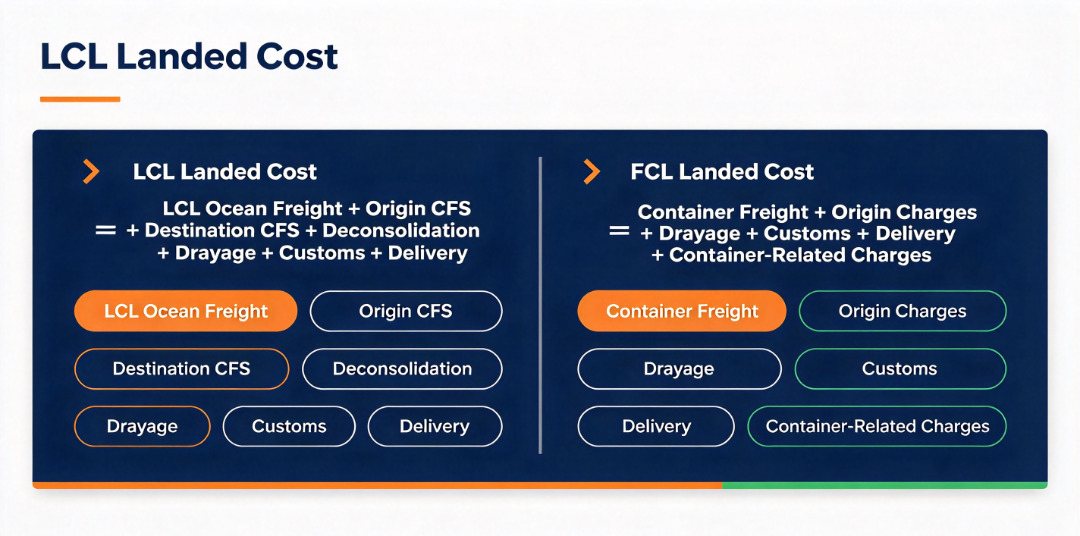
The same cargo can therefore produce two very different “cheap” quotations depending on which cost items are included.
For 2026 China-USA hardware shipments, ANL published a market comparison showing approximately $70–$110/CBM for LCL and container-based pricing for FCL. These are market observations rather than guaranteed rates; origin, destination, carrier, season and cargo characteristics can change the result. (Source: ANL, “How to Streamline Hardware and Building Materials Export to the US in 2026?”, May 24, 2026.)
For the latest tariff classification, I also recommend checking the current U.S. Harmonized Tariff Schedule rather than using an old HTS table. The USITC's current online system shows the 2026 HTS revisions and searchable tariff classifications. (Source: U.S. International Trade Commission, 2026 HTS, September 2026.)
At What Volume Does FCL Become More Attractive Than LCL?
There is no universal CBM number that makes FCL automatically cheaper.
That is because the break-even point changes with:
- 1.Origin and destination ports.
- 2.20GP, 40GP or 40HQ equipment.
- 3.LCL consolidation rate.
- 4.Destination CFS charges.
- 5.Cargo density and dimensions.
- 6.Delivery location after port arrival.
- 7.Whether the shipment needs palletization, relabeling or transloading.
A useful working model is to calculate the FCL effective cost per CBM:
FCL Effective Cost per CBM = Total FCL Cost ÷ Actual Cargo CBM
Then compare that number with the complete LCL landed cost per CBM.
Suppose an FCL option costs $3,600 and the cargo occupies 24 CBM. The effective transportation cost is $150/CBM. If the complete LCL cost is $175/CBM after destination charges, FCL may make economic sense even though the cargo does not physically fill the container.
This is more useful than using an arbitrary rule such as “under 15 CBM always use LCL.”
For recurring shipments, also calculate container utilization. If your business ships 22 CBM every month, the unused FCL capacity may be acceptable because inventory volume is predictable. If you ship 7 CBM once every four months, the same decision may create unnecessary inventory pressure.
Why Can LCL Have More Handling Risk Than FCL?
The difference is structural.
LCL cargo usually enters a consolidation process. Your cartons may be received at a CFS, grouped with other cargo, loaded into a container, discharged at destination, separated again and then prepared for domestic delivery.
Every additional touch creates another operational checkpoint.
FCL reduces some of these shared-cargo handling steps because the container is dedicated to one shipment. It does not eliminate customs inspection, port congestion, poor factory packing or final-mile damage. It simply removes part of the consolidation chain.
| Risk | LCL Exposure | FCL Exposure | Control |
|---|---|---|---|
| Extra handling | Higher | Lower | Packaging and load plan |
| CFS delay | Relevant | Less relevant | Destination planning |
| Cargo mixing | Possible | Not shared | FCL when cargo is sensitive |
| Customs exam | Still possible | Still possible | Compliance review |
There is another point that gets overlooked. A customs issue can affect more than one shipment when cargo is consolidated under the same container. The operational impact depends on the examination and entry circumstances, so LCL should never be treated as inherently “low risk” simply because the shipment is small.
When Does LCL Make More Sense Than FCL?
LCL is usually easier to justify when the cargo volume is small, demand is uncertain and inventory commitment matters more than minimizing the unit freight cost.
Typical examples include:
- · New product market tests.
- · Small replacement shipments.
- · Low-frequency purchasing.
- · Seasonal inventory with uncertain demand.
- · Orders that are materially below efficient container utilization.
There is also a cash-flow argument. If you only need 8 CBM, paying for an entire container can tie up capital in inventory and freight capacity that you do not need yet.
In January 2026, we handled 200 cartons of Bluetooth speakers from Yantian to Long Beach by ocean LCL. The shipment weighed 2,800 kg, the planned ocean freight was $1,200, and the scheduled transit time was 18 days. Two days before loading, our checklist found that the FCC ID printed on the product differed from the certificate. The factory corrected the label before loading, avoiding a potential hold and an estimated $14,000 exposure in demurrage, testing and amendment costs.
The lesson was not that LCL caused the problem. It did not. The lesson was that a small shipment still needs the same compliance discipline as an FCL shipment. The LCL decision saved the importer from committing to unnecessary container space, while the pre-shipment check protected the delivery schedule.
For importers that need flexible small-batch ocean capacity, seafreight planning should therefore begin with volume and product risk together.
When Does FCL Make More Sense Than LCL?
FCL becomes more attractive when the shipment has enough volume to spread the container cost efficiently or when the cargo benefits from fewer shared handling points.
Typical signals include:
- 1.Monthly or predictable replenishment volume.
- 2.High CBM relative to cargo value.
- 3.Fragile or easily damaged cartons.
- 4.Heavy machinery or dense products.
- 5.Strict delivery schedules.
- 6.Large numbers of SKUs that are difficult to control through consolidation.
- 7.Need for direct container delivery or transloading.
In April 2026, we handled 50 sets of outdoor resin wicker furniture from Ningbo to Savannah by FCL. Each sofa-and-table set measured approximately 1.8 m × 0.9 m × 0.7 m. The cargo was affected by an EPA TSCA documentation issue because the polyurethane foam supplier had not initially provided the required compliance statement.
The exposure was significant. A comparable shipment without the pre-booking checklist had reportedly faced a 32-day delay and approximately $9,500 in storage and re-export costs. Before booking, our team identified the missing documentation, contacted the foam supplier and obtained the TSCA statement within four days. The shipment arrived without a customs hold, with approximately three hours of internal research and $200 in supplier notarization costs.
This is why I would not choose FCL only because the cargo “looks big.” The container decision should sit inside a wider risk and compliance plan.
For containerized shipments, cabinet planning can also be evaluated against direct port delivery, transloading and final-mile requirements.
How Does Transit Time Differ Between LCL and FCL?
LCL can take longer because it contains additional consolidation and deconsolidation steps.
But the exact difference depends heavily on the lane.
| Factor | LCL | FCL | Why It Matters |
|---|---|---|---|
| Origin consolidation | Usually required | Usually not shared | Adds handling time |
| Destination deconsolidation | Required | Not for shared cargo | Can affect delivery timing |
| Ocean sailing | Lane dependent | Lane dependent | Usually similar vessel schedule |
| Final delivery | Depends on CFS release | More direct options | Important for deadlines |
ANL's May 2026 hardware shipment analysis used 18–28 days as a broad FCL ocean benchmark and 25–35 days for LCL on the referenced China-USA market comparison. Those figures are market-specific observations, not guaranteed transit times. Port congestion, carrier schedules, customs and domestic delivery can change the actual door-to-door result. (Source: ANL, May 24, 2026.)
For a business with a fixed launch date, compare the full door-to-door timeline rather than the vessel sailing time alone.
What Should You Check Before Choosing LCL or FCL?
I normally reduce the decision to seven questions.
- 1.How many CBM are you shipping?
- 2.How heavy is the cargo relative to its volume?
- 3.How often will you replenish?
- 4.How much container capacity would FCL leave unused?
- 5.How much are the LCL destination and CFS charges?
- 6.How sensitive is the product to additional handling?
- 7.What happens financially if delivery is delayed by one week?
The last question changes many decisions.
If a seven-day delay costs your business $10,000 in lost sales, paying several hundred dollars more for a more predictable logistics structure may be rational. If the cargo is low-value, non-urgent and demand is uncertain, LCL may remain the better choice even with higher per-CBM logistics costs.
For U.S. imports, transportation mode also does not remove the importer's compliance responsibilities. CBP states that even when an importer uses a customs broker, the Importer of Record remains ultimately responsible for the correctness of entry documentation and applicable duties, taxes and fees. (Source: U.S. Customs and Border Protection, Tips for New Importers and Exporters, updated source accessed September 2026.)
The FMC also regulates Ocean Transportation Intermediaries, including U.S.-based ocean freight forwarders and NVOCCs. Companies evaluating an ocean freight partner can use the FMC's licensing information as one part of supplier due diligence. (Source: Federal Maritime Commission, Bureau of Certification and Licensing, accessed September 2026.)
customs clearance should therefore be considered part of the LCL/FCL decision, not an unrelated service added after booking.
How Can You Make the Final LCL or FCL Decision?
Use this practical decision tree.
- 1.Under your efficient container utilization? Start with LCL and calculate the complete landed cost.
- 2.Near an efficient container load? Price both LCL and FCL using the same destination and delivery scope.
- 3.Heavy, fragile or irregular cargo? Give additional weight to handling exposure, not just freight price.
- 4.Recurring monthly volume? Model FCL across several shipments instead of comparing one isolated order.
- 5.Strict delivery deadline? Compare total door-to-door transit and recovery options.
- 6.High customs or product-compliance complexity? Build compliance review into either option before shipment.
One final point is worth remembering: LCL versus FCL is not a permanent decision. A company can start with LCL while testing demand, then move to FCL as volume stabilizes. Another company may use FCL for baseline inventory and LCL for small replacement orders.
The right operating model can change as the shipment profile changes.
What Is the Bottom Line in the Comparison of LCL and FCL?
LCL is usually about flexibility. FCL is usually about control and container utilization.
But neither should be selected from the ocean freight line alone.
For LCL, calculate consolidation, CFS, deconsolidation and destination costs. For FCL, calculate the actual utilization of the container and the inventory commitment created by booking dedicated space.
Then add the variables that do not appear clearly on the first quotation: cargo handling, customs complexity, delivery deadlines, damage exposure and the financial impact of delay.
That is the comparison that matters for a China-to-USA shipment.
If you are comparing two quotations now, a practical next step is a Shipping Cost Evaluation using the same cargo volume, weight, destination, customs scope and final-mile requirements. This produces a more meaningful LCL-versus-FCL comparison than looking at the ocean rate alone.
Frequently Asked Questions
1.What is the main difference between LCL and FCL?
LCL shares container space with other shipments and is generally priced around cargo volume and consolidation services. FCL reserves a complete container for one shipment and uses container-based pricing.
2.Is LCL always cheaper than FCL?
No. LCL can be cheaper for small shipments, but destination CFS, deconsolidation and local charges can reduce or eliminate the apparent price advantage.
3.At what CBM does FCL become cheaper?
There is no universal CBM threshold. The break-even point depends on the route, equipment type, LCL rate, destination charges and actual FCL utilization.
4.Is FCL faster than LCL?
It can be, because FCL normally avoids shared-cargo consolidation and deconsolidation. Actual transit time still depends on the carrier, port, customs and inland delivery.
5.Is FCL safer for fragile cargo?
FCL can reduce shared-cargo handling points, but packaging remains essential. FCL does not eliminate damage caused by poor loading, shifting or inadequate protection.
6.Can a company use both LCL and FCL?
Yes. Many importers use LCL for small or irregular orders and FCL for predictable replenishment volumes.
References
- · U.S. Customs and Border Protection — Tips for New Importers and Exporters: https://www.cbp.gov/trade/basic-import-export/importer-exporter-tips
- · U.S. Customs and Border Protection — Customs Bulletin and Decisions, importer responsibility under 19 U.S.C. §1484: https://www.cbp.gov/sites/default/files/2024-11/vol_58_no_47_title_-_complete.pdf
- · Federal Maritime Commission — Bureau of Certification and Licensing: https://www.fmc.gov/about/bureaus-offices/bureau-of-certification-and-licensing/
- · Federal Maritime Commission — Apply for a License or Request a Foreign Registration: https://www.fmc.gov/licensing-and-certification/apply-for-a-license-or-request-a-foreign-registration/
- · U.S. International Trade Commission — Harmonized Tariff Schedule: https://hts.usitc.gov/
- · AMERICAN NEW LOGISTICS — How to Streamline Hardware and Building Materials Export to the US in 2026?: https://en.anl-cn.com/newsdetail/47.html
- · AMERICAN NEW LOGISTICS — Do You Have a Self-checklist for U.S. Customs Clearance Compliance?: https://en.anl-cn.com/newsdetail/40.html
This article was compiled with AI assistance to gather industry data, and then manually reviewed, revised, and finalized by ANL specialist.